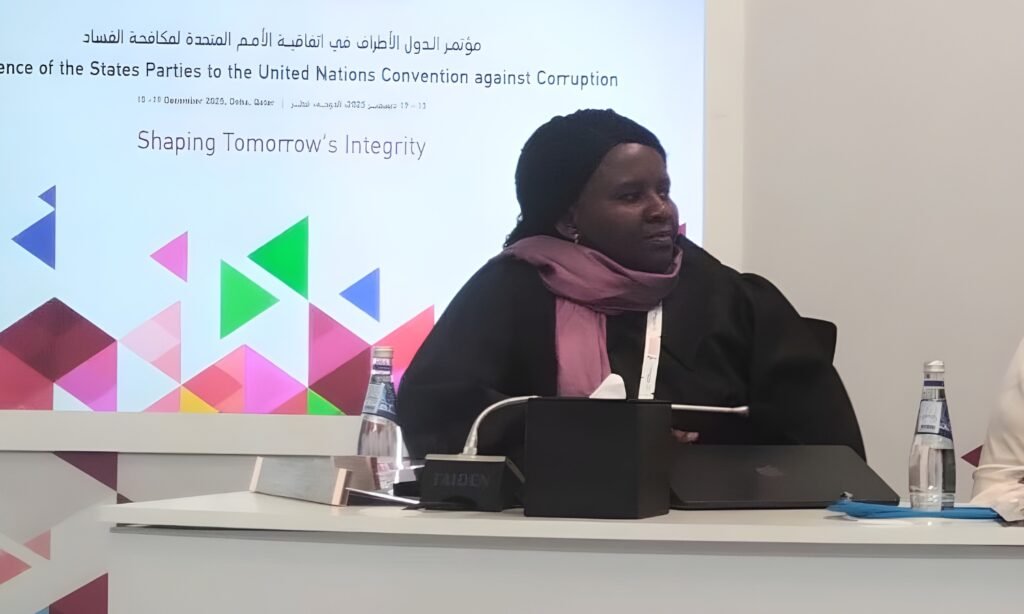
The Victims of Corruption Working Group (VoC WG) convened a strategic side meeting on 15 December 2025 in Doha, Qatar, on the margins of the Eleventh Session of the Conference of the States Parties (CoSP11) to the United Nations Convention against Corruption (UNCAC).
The meeting was chaired by Juliet Ibekaku-Nwagwu, Executive Director of the African Center for Governance, Asset Recovery and Sustainable Development, and Chair of the VoC WG, with support from Ms. Ruth Quinn of the Global Survivors Fund and Ms. Bettina Pasteknik of the Global Civil Society Coalition for the UNCAC. The session brought together Working Group members and partners to align perspectives ahead of formal panels and side events and to reinforce advocacy priorities within the broader asset recovery and anti-corruption agenda.
The VoC WG is recognized as a cross-cutting thematic group addressing the intersection of asset recovery, access to justice, victims’ rights, and civil society participation within UNCAC processes.
Key Advocacy Priorities
During the meeting, participants reiterated the Working Group’s core focus areas, including victims’ compensation in both monetary and non-monetary forms, protection of victims’ interests through litigation and asset recovery proceedings, and the meaningful participation of victims in negotiations and decision-making processes that directly affect them. Discussions also emphasized the importance of clear rules of engagement for civil society participation in asset recovery, consistent with UNCAC standards.
Information and Data Availability in Asset Recovery
Members were updated on the Information and Data Availability in Asset Recovery Database, an initiative of the Global Civil Society Coalition for the UNCAC, supported by the Cyrus R. Vance Center for International Justice. The database documents asset recovery frameworks and victim compensation practices across jurisdictions, including cases where victims have received compensation. Currently accessible through the UNCAC Coalition website, the database is expected to be fully published by the end of the first quarter of 2026 and will serve as a resource for advocacy, research, and litigation.
Contributions from Partner Organizations
Ruth Quinn, representing the Global Survivors Fund, highlighted opportunities for repatriated assets to be directed toward victims, particularly survivors of abuse linked to corruption. She emphasized the potential for asset return mechanisms to deliver justice, rehabilitation, and long-term support.
From the Cyrus R. Vance Center for International Justice, Jaime Chávez Aloe, Associate Executive Director, shared ongoing efforts to strengthen the involvement of non-traditional legal actors in victims-focused asset recovery work. These include mobilizing law firms across jurisdictions, promoting pro bono legal services, and supporting cross-border cooperation to improve access to justice for victims.
Victim Participation and Practice-Based Lessons
The Working Group also shared findings from an internal assessment of victim-related cases, particularly in jurisdictions where competent authorities have approved compensation. The assessment highlighted the need to institutionalize victim participation in asset recovery negotiations and to draw lessons from jurisdictions that have successfully operationalized victim compensation frameworks.
Linkages to CoSP11 Side Events
Discussions from the meeting directly informed upcoming CoSP11 side events, including sessions on Innovative Practices in Asset Return Cooperation and Victims’ Compensation and Justice—Tackling Impunity. These engagements are expected to advance practical and policy-oriented solutions for strengthening victim-centred approaches within asset recovery processes.
Conclusion
The meeting reaffirmed the VoC WG’s commitment to advancing victims’ rights as an integral part of anti-corruption and asset recovery efforts. Participants emphasized the importance of sustained collaboration among civil society, legal practitioners, international organizations, and States to ensure that asset recovery delivers tangible justice, redress, and accountability for victims of corruption.