Doha, Qatar | December 2025
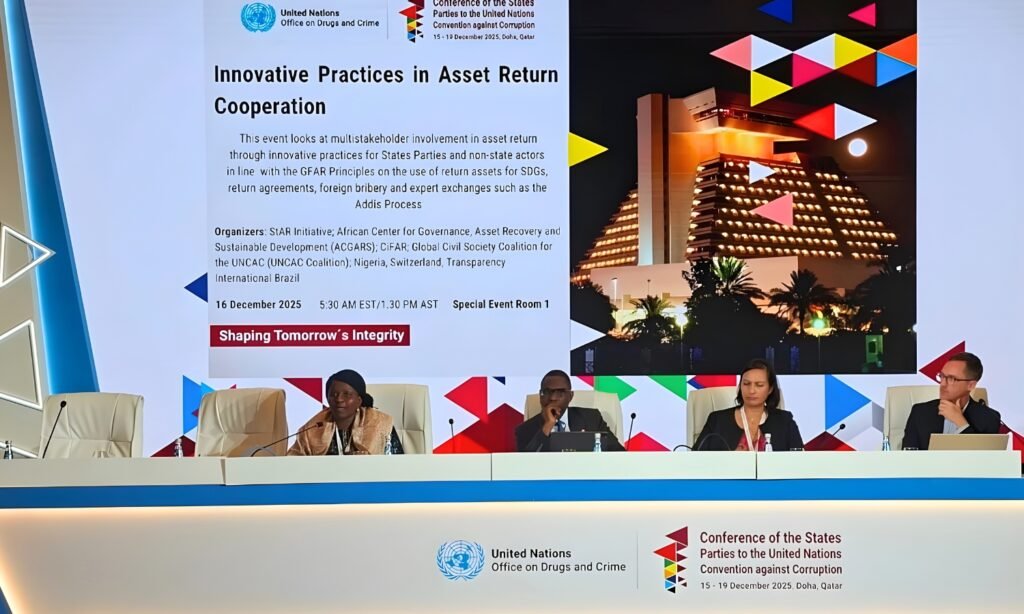
The African Center for Governance, Asset Recovery and Sustainable Development, at the 11th Session of the Conference of the States Parties to the United Nations Convention against Corruption (UNCAC CoSP11) co-hosted two high-level side events focused on innovative practices in asset return cooperation and victims’ compensation and justice. Held at the Sheraton Hotel in Doha, the sessions brought together senior policymakers, prosecutors, civil society leaders, and international experts to advance people-centered approaches to asset recovery.
The first side event explored emerging and practical approaches to enhancing international cooperation in asset recovery, with a focus on transparency, accountability, and development-oriented asset return. The panel featured Mr. Olanipekun Olukoyede, Executive Chairman of the Economic and Financial Crimes Commission (EFCC), and Madam Juliet Ibekaku-Nwagwu, Executive Director of the African Center, and other stakeholders.
In her intervention, Juliet Ibekaku-Nwagwu emphasized the critical role of civil society in asset return processes, noting that transparency, public oversight, and social reuse of recovered assets are essential for building trust and ensuring development impact. She highlighted innovative models that involve victims, communities, and non-state actors in decision-making around the use of returned assets, stressing that asset recovery must translate into tangible benefits for affected populations.
The EFCC Chairman outlined Nigeria’s experience in asset recovery and international cooperation, including engagement with foreign jurisdictions, multilateral partners, and financial intelligence networks. He highlighted ongoing reforms aimed at improving asset tracing, freezing, confiscation, and return, while underscoring the importance of trust-based cooperation, adherence to legal safeguards, and alignment of asset return with national development priorities.
Overall, the panel reinforced that effective asset return cooperation requires strong legal and institutional frameworks grounded in UNCAC Chapter V, robust international collaboration, transparent management of returned assets, and active civil society engagement to ensure accountability and public confidence.
Victims’ Compensation and Justice: Tackling Impunity
Building on the asset return discussion, the second side event—“Victims’ Compensation and Justice: Tackling Impunity”—shifted focus to ensuring that recovered assets deliver justice and reparations to victims of corruption and corruption-enabled human rights violations. The session was co-hosted by Juliet Ibekaku-Nwagwu, in her capacity as Chair of the Victims of Corruption Working Group, alongside Tatiana Huto of Ukraine’s Institute of Legislative Ideas.
Peter Madoma of Nigeria’s CLEEN Foundation presented lessons from the Abacha asset recovery process, highlighting how civil society organizations monitored the repurposing of approximately USD 321.8 million recovered through a trilateral agreement involving Nigeria, Jersey, and the United States. He explained that CSO oversight ensured transparency and accountability in the implementation of social reuse projects, including major infrastructure such as the Lagos–Ibadan Expressway and the Second Niger Bridge. According to Madoma, consistent monitoring and public reporting helped narrow longstanding trust gaps between government and citizens and demonstrated the development value of returned assets.
Madoma further noted that, in collaboration with the African Center, CLEEN Foundation developed and published guidelines to support CSOs in monitoring proceeds of crime, alongside an online platform that publicly tracks recovered assets and project outcomes.
Ruth Quinn of the Global Survivors Fund addressed the intersection of corruption, conflict, and severe human rights abuses. Drawing on experiences from conflict and post-conflict settings, she explained how corruption fuels grave violations such as torture, unlawful detention, and sexual violence, while illicit wealth linked to these abuses often remains frozen or hidden abroad. She emphasized that survivors are rights holders under international law and are entitled to effective remedies, including reparations, and called for victim-centred asset recovery frameworks that meaningfully contribute to justice, healing, and long-term recovery.
Co-host Tatiana Huto examined the growing use of sanctions regimes to target perpetrators of corruption and human rights abuses, noting that victims are frequently excluded from compensation. She highlighted emerging legal innovations in several jurisdictions that allow sanctioned or frozen assets, as well as proceeds from sanctions violations, to be redirected toward victim compensation. Huto stressed the importance of aligning sanctions frameworks with asset recovery mechanisms to ensure accountability extends beyond punishment to restitution and reparations.
Key Takeaways
Across both side events, participants converged on key priorities aligned with the African Center’s advocacy agenda: full implementation of UNCAC Article 35 on compensation, meaningful participation of victims and civil society in asset recovery processes, broader recognition of victims of corruption, and stronger integration of anti-corruption and human rights frameworks. Innovative legal tools—such as sanctions-based reparations, deferred prosecution agreements, and dedicated victim funds—were identified as critical pathways for translating asset recovery into real-world justice.
The African Center’s co-hosting of these strategic side events at CoSP11 reinforced a central message: asset recovery is not complete until it delivers justice to victims. By advancing transparent, inclusive, and development-focused approaches to asset return and compensation, the African Center reaffirmed its leadership in promoting people-centred asset recovery that restores rights, rebuilds trust, and ensures that the proceeds of corruption ultimately serve those most harmed.