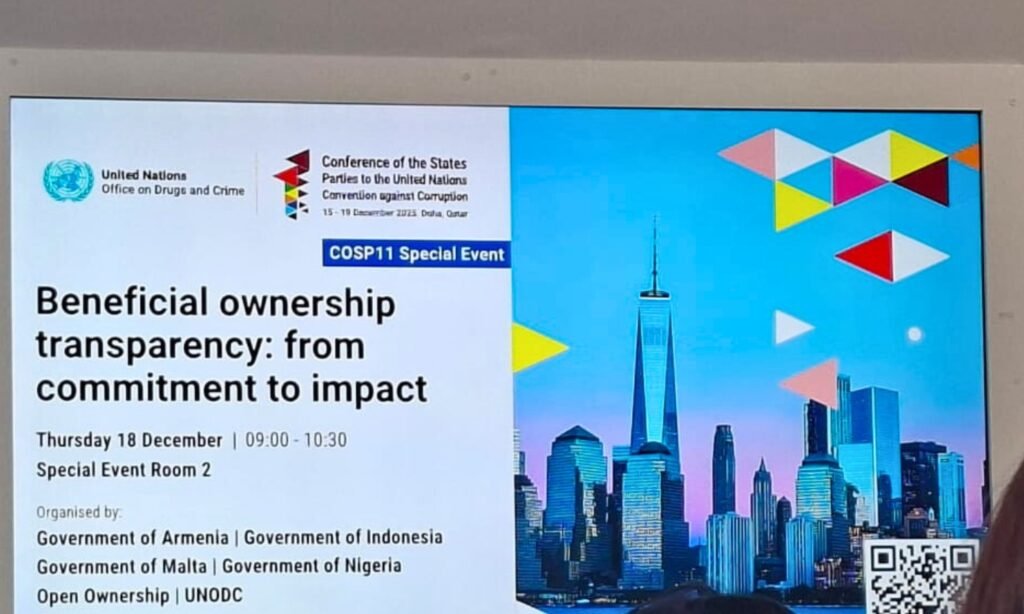
The African Center for Governance, Asset Recovery and Sustainable Development today participated in and concluded an impactful side event at the 11th Conference of the States Parties to the United Nations Convention against Corruption (CoSP11), focused on advancing beneficial ownership transparency from commitment to measurable impact. Held at the Sheraton Hotel in Doha, the session brought together representatives of the United Kingdom Government, the Government of South Africa, and the Government of Nigeria to exchange experiences, reforms, and practical tools for strengthening corporate ownership transparency and combating illicit financial flows.
A central feature of the session was a detailed presentation by the Nigeria Financial Intelligence Unit (NFIU) on the implementation of UNCAC Resolution 10/6, which addresses beneficial ownership transparency, illicit enrichment, inter-agency cooperation, and the use of digital transformation to combat complex financial crimes.
The NFIU representative underscored the critical role of Financial Intelligence Units in leveraging technology to identify opaque and layered ownership structures. She explained that the NFIU serves as Nigeria’s central authority for receiving, analysing, and disseminating financial intelligence, while also driving digital reforms aimed at improving transparency and accountability across the financial system.
The presentation highlighted Nigeria’s real-time system-to-system (S2S) API integration between the NFIU and key beneficial ownership databases, including the Corporate Affairs Commission (CAC) Beneficial Ownership Register and the Nigeria Export Processing Zones Authority (NEPZA) BO Register. This integration enables automated retrieval and verification of beneficial ownership information, detection of concealed or sudden ownership changes, and cross-matching of BO data with suspicious transaction reports, tax records, foreign exchange data, procurement databases, and banking information. To demonstrate the practical impact of these reforms, the NFIU presented a case study illustrating the use of financial intelligence and beneficial ownership data to support non-conviction-based (NCB) asset forfeiture. The case resulted in the recovery of significant assets despite ongoing criminal proceedings, highlighting how BO transparency can disrupt illicit financial flows and support asset recovery efforts.
The session also provided an overview of Nigeria’s evolving legal and regulatory framework on beneficial ownership transparency. Reforms highlighted included the Companies and Allied Matters Act (CAMA) 2020, the Persons with Significant Control Regulations 2022, the NEPZA BO Disclosure Regulations 2023, and the Legal Arrangements Regulations 2024. The CAC was identified as the supervisory authority and custodian of Nigeria’s National Beneficial Ownership Register, with tiered access for law enforcement agencies, competent authorities, and the public. Collaboration between the CAC and stakeholders such as tax authorities, the Securities and Exchange Commission, EITI, free trade zone regulators, and the private sector was emphasized as critical to the framework’s effectiveness.
The United Kingdom Government shared its experience in advancing corporate transparency through recent legislative reforms. Officials outlined the UK’s framework under the Economic Crime (Transparency and Enforcement) Act 2022, which established the Register of Overseas Entities, and the Economic Crime and Corporate Transparency Act 2023, which significantly strengthened the role of Companies House. The Register of Overseas Entities requires overseas individuals and entities owning UK property to disclose their beneficial owners, with most information publicly accessible. The register has become a valuable tool for law enforcement, journalists, and civil society in identifying corruption, money laundering, and assets linked to sanctioned individuals.
Looking ahead, participants examined emerging priorities for beneficial ownership transparency, including the development of fully digital and accessible BO databases, continuous updating and verification of ownership information, strengthened customer due diligence by financial institutions and designated non-financial businesses and professions, expanded coverage of informal trusts and legal arrangements, enhanced inter-agency database connectivity, stronger international cooperation and mutual legal assistance frameworks, and sustained civil society engagement.
Takeaways from the side event reinforced the need to move beyond formal commitments toward practical, technology-driven implementation of beneficial ownership transparency. For the African Center, the session reaffirmed the importance of its ongoing work in supporting policy reforms, strengthening institutional capacity, and promoting civil society participation to ensure that beneficial ownership transparency delivers measurable impact across national and sub-national contexts.