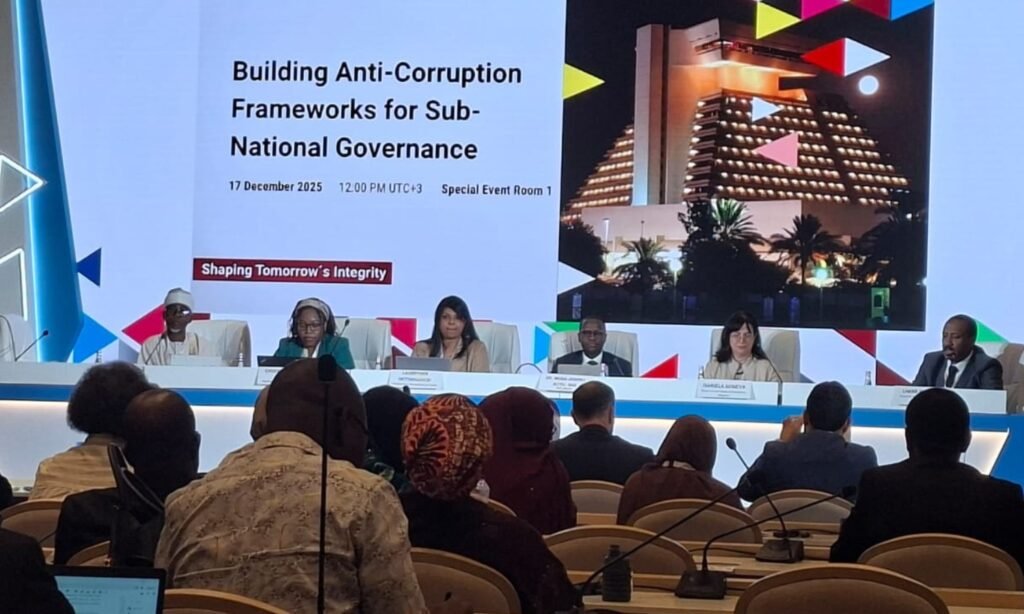
The African Center for Governance, Asset Recovery and Sustainable Development, on Wednesday, participated in a high-level side event at the 11th Conference of the States Parties to the United Nations Convention against Corruption (CoSP11), focusing on strengthening anti-corruption frameworks at the sub-national level.
The side event, titled “Building Anti-Corruption Frameworks for Sub-national Governance,” was held at the Sheraton Hotel, Doha, and brought together policymakers, analysts, and civil society leaders to examine how national anti-corruption commitments can be effectively translated into impact at state and local government levels. The panel featured Dr. Musa Adamu Aliyu, SAN, Chairman of Nigeria’s Independent Corrupt Practices and Other Related Offences Commission (ICPC); Daniela Mineva, Senior Analyst with the Geoeconomics Program at the Center for the Study of Democracy (CSD), Bulgaria; and Mr. Umar Yakubu, Executive Director of the Center for Fiscal Transparency and Public Integrity, Nigeria.
The panelists emphasized that while national anti-corruption frameworks are critical, citizens directly experience governance failures at the sub-national level. Panelists, therefore, emphasized the importance of integrating transparency, accountability, and citizen participation mechanisms into state and local institutions.
Dr. Aliyu highlighted the importance of structured collaboration between federal and state governments in Nigeria’s anti-corruption architecture. He noted that the ICPC is advancing formal Memoranda of Understanding with state governments to clearly define joint responsibilities and strengthen preventive approaches. According to him, sustained coordination, trust-building, and prevention-focused strategies such as ethics education and community sensitization offer more durable results than enforcement alone. He also stressed the need to empower ICPC regional offices to handle investigations and training locally, reducing over-centralization.
Providing a comparative perspective, Daniela Mineva drew on experiences from Southeast Europe to illustrate how decentralization can create new corruption risks if not properly managed. She explained that weak oversight of fiscal transfers and municipal procurement often exposes local governments to state capture and clientelism. Mineva emphasized the role of transparency and monitoring tools, including local transparency indices and open-budget portals, as effective mechanisms for detecting irregularities and strengthening accountability. She also highlighted the importance of civil society engagement and cross-border learning in reinforcing integrity at the grassroots. Mr. Umar Yakubu focused on Nigeria’s evolving local governance landscape, particularly in light of the Supreme Court ruling granting financial autonomy to local governments. He noted that increased autonomy must be matched with stronger accountability systems. Yakubu shared examples of ongoing initiatives in which networks of lawyers and journalists are being trained to jointly monitor local budgets and expenditures. He advocated for open budget platforms, citizen budget-tracking tools, and regular community audits to ensure that devolved resources translate into tangible public benefits.
Across the discussions, several cross-cutting themes emerged. Panelists agreed on the necessity of linking national policies with local implementation, emphasizing that neither level can succeed in isolation. There was broad consensus on the value of prevention and education, with speakers highlighting ethics training, public awareness, and civic empowerment as essential complements to enforcement. In addition, transparency technologies such as e-procurement systems, open contracting, and publicly accessible budget data were identified as practical tools for curbing corruption at the sub-national level. The event concluded with practical recommendations, including formalizing multi-level cooperation through intergovernmental agreements, expanding the capacity of regional anti-corruption offices, integrating ethics education into schools and public service training, deploying digital transparency tools at the local level, and strengthening civic oversight through partnerships with civil society and the media.
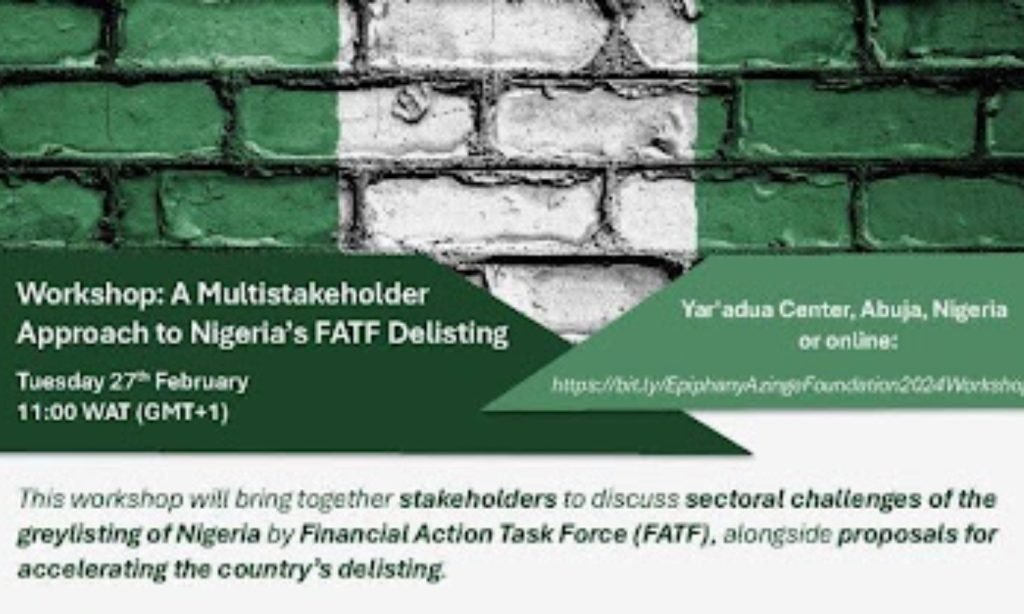
In addition to the side event, the African Center participated in a closed Civil Society Organisations (CSOs) Coordination Meeting convened on the margins of CoSP11. The coordination meeting provided a platform for CSOs to share mandates, ongoing programmes, and strategic priorities, while fostering collaboration and peer learning. During the session, the African Center presented its work on asset recovery, anti-corruption advocacy, capacity building, and policy engagement. The Center highlighted its role in supporting reforms and advocacy efforts that contributed to Nigeria’s removal from the Financial Action Task Force (FATF) grey list, underscoring the importance of sustained civil society engagement in strengthening compliance with international AML/CFT standards. Overall, the coordination meeting reaffirmed the critical role of civil society in complementing state-led anti-corruption efforts and ensuring that international commitments translate into concrete outcomes for citizens. It also strengthened collaboration among CSOs and laid the foundation for continued engagement throughout CoSP11 and beyond.