
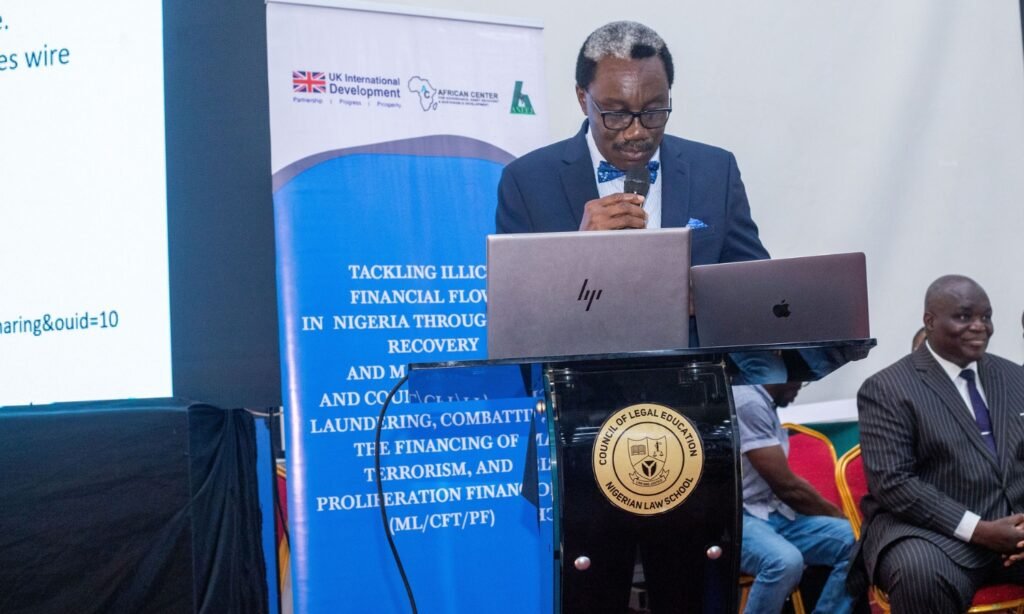
Abuja, 21 November 2025 — The African Center for Governance, Asset Recovery and Sustainable Development, in partnership with the Nigerian Bar Association Anti-Money Laundering Committee (NBA-AMLC), has successfully concluded a nationwide one-day AML/CFT sensitization workshop for aspirants to the Nigerian Bar. The programme convened at the Nigerian Law School Headquarters, Bwari Campus, Abuja, on 21 November 2025, with six additional campuses joining virtually and a total attendance of 1,340 participants.
This intervention, delivered under the FCDO-funded project “Tackling Illicit Financial Flows through Asset Recovery, Management, and Strengthening ML/CFT/PF Compliance in Nigeria,” was designed to build foundational knowledge on Anti-Money Laundering (AML), Countering the Financing of Terrorism (CFT), Counter-Proliferation Financing (CPF), and the ethical obligations prescribed under Chapter Two of the Rules of Professional Conduct for Legal Practitioners (RPC 2023). The programme was informed by the NBA Legal Sector AML/CFT Risk Assessment (2024) and global FATF standards, identifying legal professionals as gatekeepers of the financial system.
The sensitization workshop was designed to deepen aspiring legal practitioners’ understanding of critical AML/CFT/CPF concepts, red flags, compliance obligations, and ethical expectations in Nigeria’s evolving legal and regulatory environment. The engagement further sought to reinforce a culture of integrity among future lawyers, who play a central role as gatekeepers in preventing illicit financial flows.
Workshop presentations and highlights
Opening presentation — Dr. Esa Onoja (Member, NBA-AMLC)
The workshop opened with a lecture by Dr. Esa Onoja, a member of the NBA-AMLC, who provided historical and conceptual grounding in money laundering. He traced the origin of the term to the use of laundromats in the 1920s to launder cash for organized crime, explaining how criminals move funds through financial systems and cash-intensive, legitimate-looking structures to disguise their source. Dr. Onoja emphasized that combating money laundering is essential to protecting the integrity of Nigeria’s economic and legal systems, noting the NBA-AMLC’s role in strengthening legal-sector compliance.
Technical Presentation by Prof. Ernest Ojukwu, SAN
A significant highlight of the workshop was the technical presentation delivered by Prof. Ernest Ojukwu, SAN, Co-Chair of the NBA-AMLC. His lecture provided a comprehensive overview of the global challenges of money laundering and terrorism financing, detailing the three stages of money laundering—placement, layering, and integration —and presenting practical case analyses drawn from real-world scenarios.
Prof. Ojukwu outlined the obligations imposed on legal practitioners under the Money Laundering (Prevention and Prohibition) Act 2022, the Terrorism (Prevention and Prohibition) Act 2022, and Chapter Two of the Rules of Professional Conduct for Legal Practitioners (RPC 2023). He further highlighted the role of the Financial Action Task Force (FATF) and the significance of Recommendation 23, which classifies lawyers as critical gatekeepers in detecting and reporting suspicious activities.
Participants were taken through essential compliance requirements, including client due diligence, record keeping, confidentiality exceptions, sanctions list screening, suspicious transaction reporting, and the responsibilities associated with managing client accounts. Practical demonstrations, case studies, ethical scenarios, and interactive quizzes helped deepen participants’ understanding.
Goodwill remarks
The Director-General of the Nigerian Law School, Professor Isa Hayatu Chiroma, SAN, delivered goodwill remarks, welcoming the partnership and stressing the importance of embedding AML/CFT literacy and professional ethics in legal training. He encouraged students to adopt the principles shared during the workshop as part of the standards expected of modern legal practice.
Learning outcomes, participation, and impact
The Monitoring & Evaluation (M&E) findings show substantial and measurable learning gains and broad engagement:
- Attendance & reach: 1,340 participants across seven campuses (physical and virtual), demonstrating strong interest and engagement.
- Demographics: The cohort was predominantly young (≈88% under 30) and largely female (73.13%), with geographic clustering in Abuja (55.07%), Port Harcourt (20.52%), Enugu (12.54%), and Bayelsa (11.79%); Kano participation was minimal (0.07%).
- Knowledge gains: Average scores rose from 44.2% (pre-training) to 89.37% (post-training) — a 45.17 percentage-point increase. Key post-training achievements included near-universal recognition of Chapter Two RPC obligations (97.47%) and substantial gains in identifying money-laundering concepts (94.94%).
- Participant feedback: Qualitative responses recorded high satisfaction with content relevance, facilitator delivery, and practical exercises; interactive case studies and scenario work were particularly valued.
Key recommendations and next steps
Based on workshop outcomes and M&E evidence, the African Center will recommend the following actions in collaboration with the NBA-AMLC and partners:
- Curriculum integration: Explore formal incorporation of AML/CFT modules into the Nigerian Law School curriculum, and consider embedding core AML/CFT questions into the Bar Part II Ethics examination to reinforce learning.
- Targeted outreach: Intensify engagement with underrepresented campuses (notably Kano) using hybrid and virtual modalities to improve equitable coverage.
- Continuous professional development: Institute periodic refresher sessions, an annual AML/CFT week for law students, and mentorship links with practitioners and regulators.
- Monitoring & evaluation: Implement follow-up assessments at three and six months to measure retention and inform iterative improvements.
Conclusion
The African Center expresses its appreciation to the Nigerian Law School, the NBA-AMLC, its funding partner, the UK FCDO, the project implementing partner – ANEEJ, and all resource persons who contributed to the success of this engagement. The Center remains committed to supporting capacity-building initiatives that enhance professionalism, uphold ethics, and foster effective AML/CFT compliance across Nigeria’s legal landscape.
Media contact:
The African Center for Governance, Asset Recovery and Sustainable Development
Email: info@africancenterdev.org
Website: https://africancenterdev.org/