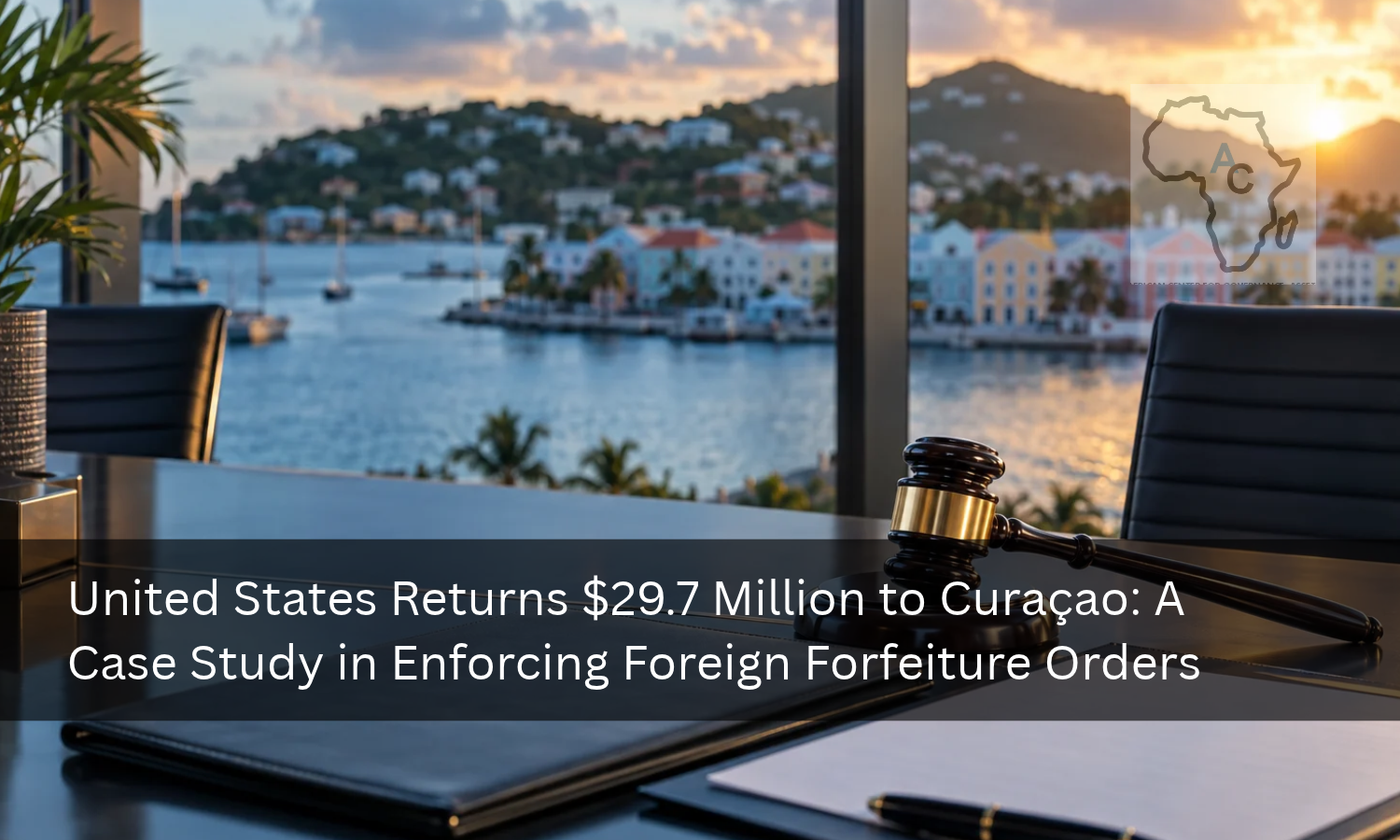
United States Returns $29.7 Million to Curaçao: A Case Study in Enforcing Foreign Forfeiture Orders
In a separate development, the U.S. Department of Justice said it would transfer approximately $29.7 million to the Government of Curaçao in three instalments. The funds represent proceeds of an eight-year fraud and money laundering scheme involving an unlicensed lottery and unpaid taxes on its earnings and other income, run against the Curaçao government.
The Case
According to court documents, Robertico A. Dos Santos orchestrated the scheme and was prosecuted and convicted in Curaçao. At Curaçao’s request, the U.S. Justice Department’s Money Laundering, Narcotics, and Forfeiture Section (MNF) obtained an order from the U.S. District Court for the District of Columbia enforcing a pre-trial restraining order that a Curaçao court had issued against the illegal proceeds, which Dos Santos had deposited in investment accounts at a Miami bank through companies he controlled.
After his conviction and sentencing in Curaçao, MNF again acted at Curaçao’s request, securing a U.S. court order enforcing the Curaçao court’s final forfeiture order against the restrained funds.
The Justice Department describes the transfer as recognition of Curaçao’s losses and its assistance in the case, intended to strengthen bilateral cooperation on transnational financial crime, money laundering, corruption, human trafficking and asset forfeiture more broadly.
Lessons for Africa’s Asset Recovery Practice
Although this case did not originate in Africa, the enforcement mechanism it demonstrates is directly relevant to the asset recovery frameworks the African Center promotes across the continent. Importantly, it shows how a requesting state can secure the return of proceeds without relitigating its case from scratch in the country holding the assets.
The mechanism also accords with established asset recovery practice. StAR guidance on legal tools for asset recovery identifies enforcement or registration of foreign restraint and confiscation orders as an important component of cross-border recovery, while its mutual legal assistance guidance stresses the need for a clear legal basis, appropriate procedures and active engagement with foreign counterparts.
Several features are worth highlighting for African practitioners and policymakers.
1. Foreign judgments can be enforced directly.
Rather than pursuing a fresh U.S. prosecution, Curaçao’s own restraining and forfeiture orders were recognized and enforced by a U.S. court. This illustrates a route that African states with strong domestic judgments or forfeiture orders may consider where the legal framework of the requested jurisdiction permits such enforcement.
2. Sustained bilateral engagement matters more than a single request.
Curaçao’s authorities engaged the U.S. process twice: first for restraint and later for final forfeiture. The sequence underscores that recovery is a multi-year relationship with foreign counterparts, not a one-time ask.
3. Transparent, audited return terms build trust.
The public audit and reporting conditions attached to the Curaçao transfer are a model African government can point to when negotiating the terms of their own repatriations, to reassure both citizens and returning jurisdictions that funds will be properly managed. This is consistent with StAR guidance on the management of stolen assets, which emphasizes transparent, accountable and effective management and disbursement of recovered assets.
African governments can point to arrangements of this nature when negotiating the terms of their own repatriations, helping to reassure both citizens and returning jurisdictions that recovered funds will be properly managed.