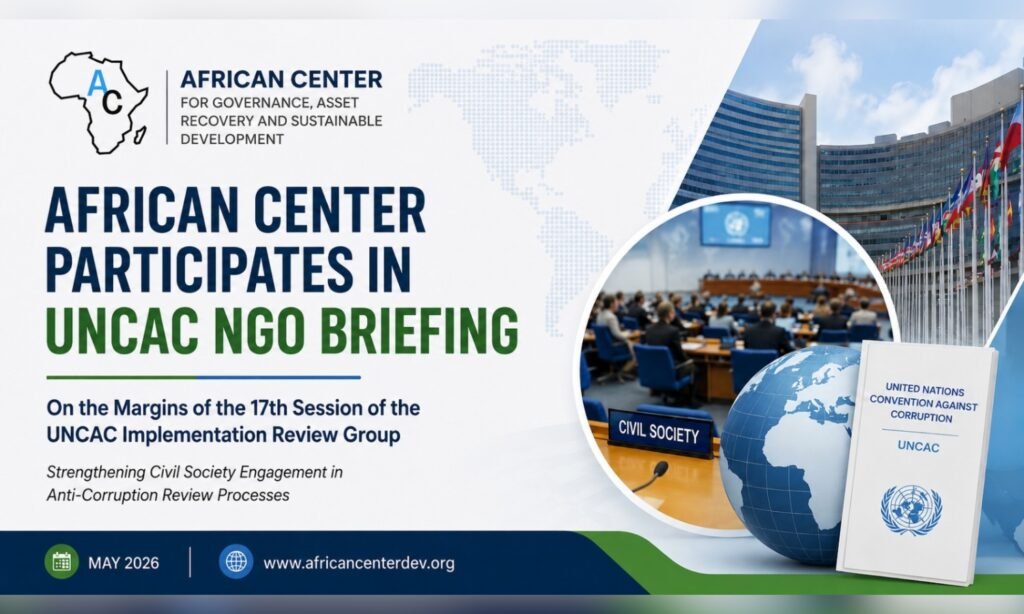
The African Center for Governance, Asset Recovery and Sustainable Development participated in the Briefing for Non-Governmental Organizations (NGOs) convened on the margins of the Seventeenth Session of the Implementation Review Group (IRG) of the United Nations Office on Drugs and Crime under the United Nations Convention against Corruption (UNCAC), held on 19 May 2026 at the Vienna International Centre, Vienna, Austria.
The engagement brought together civil society organizations, governance experts, anti-corruption practitioners, development partners, and representatives of States Parties to review progress under the UNCAC Implementation Review Mechanism (IRM), examine emerging corruption risks, and strengthen international cooperation on accountability, transparency, and asset recovery systems.
A major highlight of the briefing was the announcement by the UNCAC Secretariat that approximately 70 percent of second-cycle reviews under the IRM have now been completed ahead of schedule, marking a significant milestone in the 16-year history of the review process. The Secretariat disclosed that:
- Over 360 executive summaries have been adopted;
- More than 340 countries review engagements and dialogues have been conducted;
- More than 10,000 recommendations have been issued to States Parties;
- Approximately 90 percent of the recommendations were considered actionable;
- Around 1,600 good practices have been identified globally; and
- Close to 4,800 technical assistance needs have been mapped to support reforms and implementation efforts.
Key Issues Discussed
The meeting discussed several governance, anti-corruption, and implementation challenges emerging across regional reviews under UNCAC, including:
- Public sector integrity and codes of conduct;
- Beneficial ownership transparency and private sector accountability;
- Political finance transparency and conflict-of-interest management;
- Public access to information and citizen participation;
- Anonymous corruption reporting mechanisms;
- Illicit financial flows and abuse of corporate structures;
- Corruption linked to organized crime and debt management vulnerabilities;
- Youth participation and intergenerational engagement in anti-corruption processes; and
- Sustainability of funding for the Implementation Review Mechanism.
Discussions highlighted that many States Parties continue to receive recommendations relating to public sector recruitment transparency, preventive anti-corruption policies, beneficial ownership registries, and broader accountability obligations under Articles 5 to 13 of UNCAC.
Participants also reflected on notable good practices identified through the review process, including:
- Preventive anti-corruption strategies;
- Public integrity and ethics frameworks;
- Transparency and public participation mechanisms;
- Beneficial ownership reforms;
- Regional anti-corruption cooperation initiatives; and
- Civil society engagement models supporting accountability systems.
Key Outcomes and Emerging Priorities
The briefing highlighted several ongoing and emerging reforms within the UNCAC review architecture.
It was agreed that:
- The next phase of the IRM will include an enhanced preparatory phase before peer reviews;
- Review timelines may extend to approximately 17–18 months to improve country readiness and stakeholder participation;
- Updated guidance notes and self-assessment checklists will be developed to improve recommendation quality and country-context relevance;
- Greater emphasis is needed on actionable and implementation-focused recommendations;
- Civil society participation remains essential to strengthening transparency and accountability processes; and
- Improved coordination between anti-corruption, human rights, and organized crime frameworks is increasingly necessary.
The Secretariat also highlighted ongoing collaboration between UNODC and the Office of the United Nations High Commissioner for Human Rights on corruption and human rights-related policy discussions, alongside efforts to strengthen access-to-information systems and public accountability mechanisms globally.
Civil Society and Youth Engagement
Participants emphasized the growing role of civil society organizations in supporting UNCAC implementation, transparency monitoring, and institutional accountability.
The briefing noted that:
- More than 400 civil society organizations are currently engaged within the UNCAC ecosystem;
- 46 States Parties have endorsed the Transparency Pledge supporting greater openness and civil society inclusion in second-cycle reviews; and
- Civil society contributions continue to shape review guidance, implementation monitoring, and reform advocacy.
The meeting also highlighted expanding youth participation under the GRACE Initiative, which now includes youth representatives from over 40 countries alongside mentorship programmes connecting young anti-corruption advocates with experienced practitioners and experts.
Next Steps Identified
Participants identified several priority next steps for strengthening UNCAC implementation and review processes, including:
- Development of improved review guidance and self-assessment tools;
- Expanded technical assistance and regional cooperation support;
- Resource mobilization to sustain IRM operations and implementation activities;
- Enhanced collaboration between UNCAC mechanisms and complementary human rights and governance frameworks;
- Greater inclusion of youth and civil society actors in anti-corruption policymaking processes; and
- Continued engagement on emerging corruption risks linked to organized crime, professional service providers, and illicit financial flows.
African Center’s Engagement in UNCAC Processes
The African Center has continued to engage regional and international anti-corruption processes through:
- Participation in UNCAC-related policy engagements, stakeholder consultations, and governance dialogues;
- Advocacy on asset recovery effectiveness, beneficial ownership transparency, and illicit financial flows;
- Contributions to discussions on AML/CFT compliance, accountability systems, and governance reforms across Africa;
- Collaboration with legal, policy, and anti-corruption stakeholders at national, regional, and international levels; and
- Publication of policy submissions and technical recommendations under international anti-corruption processes.
The Center’s recently published its written submission to the Seventeenth Session of the UNCAC Implementation Review Group titled “Enhancing Asset Recovery Effectiveness Through Digital Innovation and Inclusive Oversight” was officially published by the United Nations Office on Drugs and Crime (UNODC) as part of the session’s stakeholder documentation and contributions.
We remain committed to supporting international, regional, and national efforts aimed at strengthening transparency, advancing effective asset recovery systems, combating illicit financial flows, promoting accountability, and encouraging inclusive governance frameworks that contribute to sustainable development across Africa.
For more information about the African Center and its work on governance, anti-corruption, and asset recovery, visit African Center for Governance, Asset Recovery and Sustainable Development or contact the organization via email at: info@africancenterdev.org